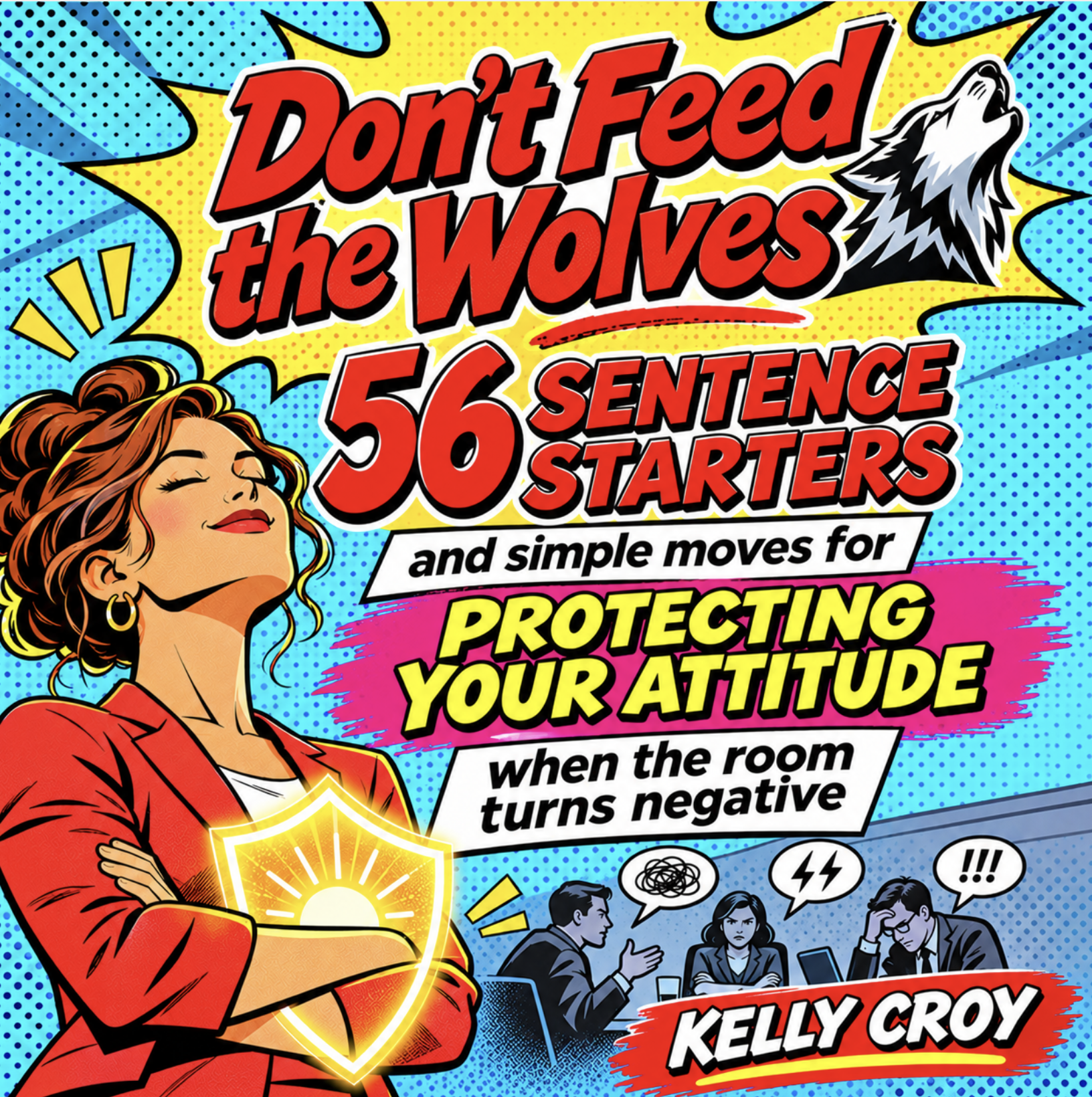
56 sentence starters and simple moves for protecting your attitude when the room turns negative
By Kelly Croy
When I taught seventh-grade English, my favorite classroom trick cost nothing and worked every single time. I wrote the first half of a sentence on the board, added three dots, and let the kids finish it. Kids who never raised a hand suddenly had plenty to say. The dots did the heavy lifting because they gave a nervous brain somewhere to start.
I spent 26 years in the classroom, and I'm convinced of one thing. Adults need the dots too. Leaders might need them most.
You know this room. It's 10:42 on a Tuesday, and you walked into the teachers' lounge for a cup of coffee and thirty seconds of peace. Somebody is already rolling. The new schedule is a mess. Nobody upstairs has a clue. Don't even get them started on that committee. Heads are nodding, someone laughs, and then the whole room seems to look at you.
You don't want to join in. You don't want to start a fight either, and you really don't want to be the person who sucks the air out of the lounge. So you do what most of us do. You nod a little. You manage a polite chuckle. You stir your coffee like it's your job.
I've done it more times than I'd like to admit. Every time, I walked out feeling a little smaller, like I'd paid a toll to stay in the club.
I call that feeding the wolves. A pack doesn't need much. A nod is a snack, a chuckle is dinner, and if you hang around long enough they'll start saving you a seat.
This post is a tool kit for that moment. It gives you words to say, moves to make, and a simple way to decide which one fits. Nobody gets embarrassed and nobody gets lectured, and your integrity stays right where you left it.
Most importantly you make a contribution to the place you want to work at.
What You Permit, You Promote
The late Tim Kight, founder of Focus 3, taught leaders a line worth taping to your bathroom mirror: “What you permit, you promote.”
A quiet face in a room full of complaining reads as a yes. A nod reads as a vote. A polite laugh reads as a standing ovation. You may have meant none of it, but the room heard all of it.
Silence doesn't always mean agreement, and I'll say that plainly. Some days the wise move is to keep your mouth shut and let the storm pass. Nobody is handing you a badge and a whistle to become the negativity police. You’re not the supervisor, the principal, the administrator, but you have influence and a leadership responsibility. What are you going to do? The goal is smaller and a lot more doable. Protect your boundaries, your integrity, and your energy, and treat everyone in the room with dignity while you do it.
Three Moves: Recognize, Redirect, Remove
Everything in this post fits inside three moves. Learn these and the rest is just vocabulary.
1. Recognize. Listen to where the conversation is heading. Are people raising a real concern, or has it turned into negativity, gossip, blaming, complaining, and defending? Those drain the energy out of a team faster than any budget cut, and spotting them early is half the battle.
2. Redirect. If you're comfortable, use a sentence starter, ask a better question, or take a small physical action that nudges the conversation somewhere useful.
3. Remove. If the room keeps heading somewhere you won't go, give yourself permission to leave. You don't owe anyone a speech on the way out.
You don't have to win an argument or change anyone's attitude. You don't have to prove you're the most positive person in the building. You just have to decide, on purpose, how you'll respond.
Sentence Starters: Pick Your Level
I sorted these into three levels, like a video game. Nobody starts on the boss fight, so begin where you're comfortable and level up as your confidence grows. The three dots mean you finish the sentence in your own words, exactly like my seventh graders did.
Level 1: Rookie Mode
Low-risk lines that gently steer the conversation.
“I wonder if there's another way to look at...”
“I'm not sure we have the whole story, so...”
“I'd rather spend my energy on...”
Rookie tip: You don't have to change anyone's mind. Declining to agree counts as a win.
Level 2: Challenger Mode
Confident lines that turn complaints toward solutions.
“Instead of asking who's responsible, what if we...”
“What if we focused on something we can actually control, like...”
“I see that a little differently because...”
Challenger tip: A good question beats a lecture almost every time. People defend against speeches, but they'll chew on a question.
Level 3: Leader Mode
Clear, respectful boundaries for when a conversation turns destructive.
“I'm not comfortable talking about someone who isn't here, so...”
“I'd rather have this conversation directly with...”
“I'm going to step away because...”
Leader tip: Direct isn't the same as disrespectful. You can draw a line without attacking anybody's character.
You don't need Leader Mode every time. Plenty of days, a Rookie line or a quiet exit is the most mature move in the room.
Physical Moves: When Words Aren't Needed
Sometimes you don't need a sentence at all. You need to move. Your body can say what your mouth doesn't want to, and these work the same way, in three levels.
Level 1: Rookie Mode
Stop nodding. Nodding says “I agree” even when you only meant “I'm listening.”
Keep a neutral face. You don't owe a smile to a comment you disagree with.
Excuse yourself for water or coffee. It's a natural exit that nobody questions.
Level 2: Challenger Mode
Stand up. It tells the room you're moving on before you say a word.
Join another conversation. Go find the people talking about something worth talking about.
Write down one possible solution. It pulls your brain out of frustration and into action.
Level 3: Leader Mode
Leave quietly. You don't have to announce your disapproval, because walking out says plenty.
Make the constructive phone call. Go get the answer instead of guessing about it with the group.
Change the subject on purpose. Bring up something good and invite others to join you.
You never have to explain these moves. Protecting your boundaries doesn't require a press conference. Our district has a great rule: Talk to People, Not About People.
Not Every Complaint Is a Wolf
Let me be clear, because this matters. People need to raise concerns, question decisions, and say hard things out loud. Healthy organizations depend on folks who will be honest about what's broken, and we should never use positivity as an excuse to shush someone who needs to be heard.
Telling the truth about a problem is not the same as complaining about it for the tenth time with no plan to fix it. Holding someone accountable is not the same as trashing them behind their back. Respectful disagreement is not the same as building a culture of grumbling.
The aim is to make hard conversations more productive, not to get rid of them. If you're dealing with harassment, discrimination, threats, or other serious misconduct, a sentence starter and a quiet exit won't cut it. Those situations call for real reporting and real follow-through. Contact a supervisor, a Title IX officer, or HR.
Check Yourself First
Before we go hunting for other people's negativity, take a look in the mirror. Think about the last time you sat in a conversation that went sour. Did you add fuel? Did you laugh at someone's expense? Did you nod along while your gut said no?
Ask yourself one question this week: when was the last time my silence, my laughter, or my nodding encouraged something I didn't believe in? You can't expect to influence anyone else's attitude if you won't examine your own. Pay attention to what you contribute, what you encourage, and what you allow. Don’t be a wolf.
Protecting Your Energy Isn't Selfish
Attitudes are contagious. Spend enough time around people who complain, and you start noticing everything that's wrong. Spend time around people who look for possibilities, take responsibility, and lift others up, and you start seeing opportunities you walked right past before. It’s difficult to speak negatively of someone when another is praising them. Once we know their story, we understand why they behave the way they do.
None of this means avoiding people who are struggling or refusing to listen when someone needs support. It means you have choices. You can listen without agreeing, care without joining in, and disagree without becoming disagreeable. You can leave a conversation without making anyone feel small, and that skill alone sets good leaders apart.
Your Challenge This Week
Dislike the behavior, not the person. Seriously, one of the best lines in leadership I ever heard.
Pick one sentence starter and one physical move. Write them on a sticky note and put it somewhere you'll see it, like your planner or the dashboard of your car. Say the sentence out loud a few times, because it will feel awkward at first and a lot less awkward by Friday.
Then wait for the moment. It's coming, probably before lunch on Tuesday. When it does, you'll be ready instead of caught off guard, and you'll respond on purpose instead of out of habit.
You don't need to memorize a pile of sentence starters. You need two tools that sound like you. If you want the whole collection, I put all 56 sentence starters and moves on a free one-page cheat sheet, and I'll send you a copy if you email me at kelly@kellycroy.com.
Recognize it. Redirect it. Remove yourself when you have to. The next time somebody asks what you think, you'll have the dots, and you'll know exactly how to finish the sentence. Protect your boundaries, protect your attitude, and don't feed the wolves.
Let's Do This Work Together
If this made you think about your school, organization, team, or your own leadership, I would love to work with you. I speak, coach, and lead workshops on leadership, attitude, and building cultures worth belonging to. You'll find my books, speaking, and coaching at KellyCroy.com. I want to speak at your event.
Leadership matters. Let's give this world something worth following.
Keep being awesome,
~Kelly Croy
Speaker • Author • Educator
Kelly Croy
56 Sentence Starters & Simple Moves to Build a Better Culture
Level 1: Rookie Mode
"I wonder if there's another way to look at..."
"I'm not sure we have the whole story, so..."
"That's an interesting perspective. I wonder..."
"Maybe there's something we're missing about..."
"I hadn't thought about it that way, but..."
"I wonder what their perspective would be if..."
"Maybe we should give them the benefit of the doubt because..."
"I'm trying to focus more on..."
"I wonder what we could do to improve..."
"That's frustrating. Maybe we could..."
"I'd want to hear their side before I decide what I think about..."
"I'd rather spend my energy on..."
Level 2: Challenger Mode
13. "I see that a little differently because..."
14. "Before we make that assumption, maybe..."
15. "I wonder what would happen if we..."
16. "Instead of asking who's responsible, what if we..."
17. "We've spent a lot of time on the problem. Maybe..."
18. "What if we focused on something we can actually control, like..."
19. "I think there's another side to this that..."
20. "Have we considered asking that person..."
21. "I don't know if that's necessarily true because..."
22. "What would a good outcome look like if..."
23. "Maybe we could spend some time thinking about..."
24. "I'm wondering if this conversation would be more productive if..."
Level 3: Leader Mode
25. "I don't really agree with that assessment because..."
26. "I'm not comfortable talking about someone who isn't here, so..."
27. "I don't think this conversation is helping us..."
28. "I'd rather have this conversation directly with..."
29. "I respect your perspective, but I believe..."
30. "I'm choosing not to take part in conversations that..."
31. "I think we're making assumptions that..."
32. "I'm going to step away because..."
33. "I don't want to contribute to something that..."
34. "I believe we have a responsibility to..."
35. "I'm concerned that this conversation might..."
36. "I think the best thing we can do right now is..."
Physical moves (37 to 56)
Level 1: Rookie Mode
37. Stop nodding. Nodding says "I agree" even when you only meant "I'm listening."
38. Keep a neutral face. You don't owe a smile to a comment you disagree with.
39. Pause before you respond. A few seconds of quiet keeps you from agreeing on autopilot.
40. Turn toward your work. Point your attention at something that matters.
41. Pick up your notebook. Refocus on your responsibilities.
42. Excuse yourself for water or coffee. A natural exit nobody questions.
43. Head back to your workspace. Sometimes the best move is getting back to work.
Level 2: Challenger Mode
44. Stand up. It tells the room you're moving on.
45. Gather your belongings. Closing your laptop signals you're done participating.
46. Move to another seat. Create distance without creating drama.
47. Join another conversation. Find the people talking about something productive.
48. Write down one possible solution. Shift from frustration to action.
49. Invite someone for a walk. A new setting can change the conversation.
50. Open your calendar. Suggest scheduling a real discussion with the people who can fix the problem.
Level 3: Leader Mode
51. Leave quietly. You don't have to announce your disapproval.
52. Invite the right person into the conversation. Encourage direct communication over speculation.
53. Make the constructive phone call. Get clarity instead of guessing as a group.
54. Start working on a solution. Replace complaining with purposeful action.
55. Change the subject on purpose. Bring up something constructive and invite others in.
56. Model the conversation you want. Turn toward the work, the goal, or the people who need you.
The BEST advice: Have the conversation! The obstactle is the way. Go to the place you don’t want to go. See the person you don’t wany to see. Talk about the issue you have been avoiding. Listen to learn. Share your position. Move on.